In the weeks that followed our 15-year-old daughter’s funeral, grief settled into our home like a heavy fog. My husband and I mourned in different ways—he sought distraction, tasks, and motion, while I found myself standing still, unable to let go of the spaces she once filled. One evening, he quietly suggested that we begin clearing out her room, believing that removing her belongings would ease the pain. But I wasn’t ready. Her room still felt like her—the soft colors she loved, the photos taped crookedly on the wall, the faint scent of her perfume lingering in the air.
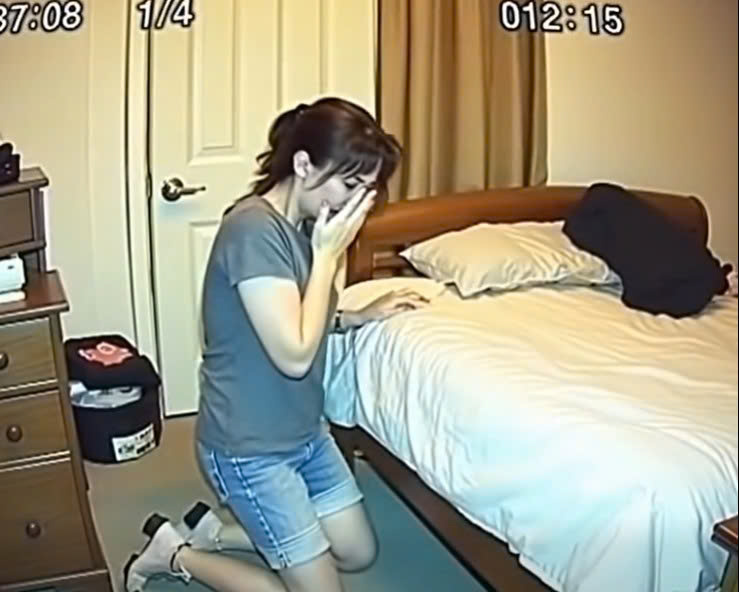
Still, something inside me knew it was time to take a small step. I walked into her room, closed the door gently, and sat on the edge of her bed. My hands trembled as I reached beneath the frame, thinking I might find a fallen sock or an old notebook. Instead, my fingers brushed against something solid—a dusty, worn shoebox I had never seen before.
A jolt of curiosity mixed with dread ran through me. Carefully, I pulled the shoebox into the light. It looked old, the edges soft from years of being handled. I hesitated for a long moment before lifting the lid, unsure of what I was about to uncover.
Inside was an unexpected collection of items, each placed with intention: a small stack of letters tied neatly with a ribbon, a delicate bracelet, a family photo worn at the corners, and a handheld tape recorder. None of these were random. These were parts of her world—pieces she had gathered, protected, and chosen to hide for reasons I did not yet understand.
With trembling fingers, I reached for the letters first. They were addressed to me in her familiar handwriting, looping and imperfect. As I untied the ribbon and unfolded the first letter, her voice rose from the page. She wrote about things she had never said aloud—how she sometimes felt she didn’t fit in, the pressure she felt to be perfect, the fear of disappointing us, the loneliness she carried quietly despite being surrounded by family.
Each letter opened a door to corners of her heart I hadn’t known existed. She shared her dreams, her joy in small things, her humor tucked between lines, and her struggles that she had worked so hard to hide. Tears fell freely as I read her words, the ink blurring beneath drops that fell faster than I could wipe them away. My heart ached with regret. I wished I could reach through time and hold her, tell her she was never alone, and that she was more loved than she ever realized.
Next, I picked up the bracelet—a simple, delicate piece with tiny charms. I recognized it as a gift from her childhood friend. She had worn it often when she was younger, but I hadn’t seen it in years. Tucked beneath it was a small note describing what that friendship had meant to her. It was a reminder that sometimes friendships become lifelines, even when parents don’t realize their significance.
When I lifted the family photo, something inside me broke open. It was one we had taken years earlier on vacation—her smile wide and bright. Around each of our faces, she had drawn small hearts in pen. Even during the times when she struggled silently, she still carried love for us. That was the part that made my breath catch—knowing she loved us deeply, even when life felt heavy for her.
Finally, my eyes fell on the old tape recorder. I hesitated before pressing play, afraid of what I might hear, afraid of reopening wounds that had barely begun to close. But when her soft voice filled the room, I felt something shift within me. She spoke openly, sharing her gratitude, her fears, her hopes for our family. She talked about trying her best, even when she didn’t know how to explain what she was feeling. She talked about loving us, even on days when she couldn’t find the words.
Listening to her voice was like being wrapped in a bittersweet embrace—a reminder of her presence and a reminder of her absence all at once. The message she left was profound and gentle, full of love and honesty. It was her way of reaching out, even after she was gone.
Sitting in the middle of her room, surrounded by these pieces of her world, I finally understood: these weren’t items meant to stir pain. These were gifts she had left unknowingly—a bridge between her heart and mine, a chance to see her more clearly, a path toward healing that I didn’t realize I needed.
My husband believed that clearing out her things would make it easier to move on. But for me, these discoveries became a reason to hold on just a little longer. Not to grief itself, but to her memory, to her life, to the love she quietly poured into every object in that shoebox.
When I finally closed the lid, I pressed it gently to my chest. I took a deep breath and felt something I hadn’t felt in weeks—warmth. A small, fragile warmth that whispered she was still with us in some way. Not physically, but in spirit. In love. In the memories she left behind.
The shoebox remained under our bed afterward, not hidden but honored. A reminder that healing doesn’t always come from letting go. Sometimes, it comes from holding on to the right things—the pieces that remind us of love, connection, and the bond that even loss cannot erase.