The morning began like countless others on the construction site. The bridge stretched across the river, its steel framework rising confidently above the water as workers moved with practiced rhythm. Welding torches sparked, hammers rang against metal, and heavy machinery hummed in steady harmony. To anyone watching, it appeared to be just another productive day in the life of a growing city.
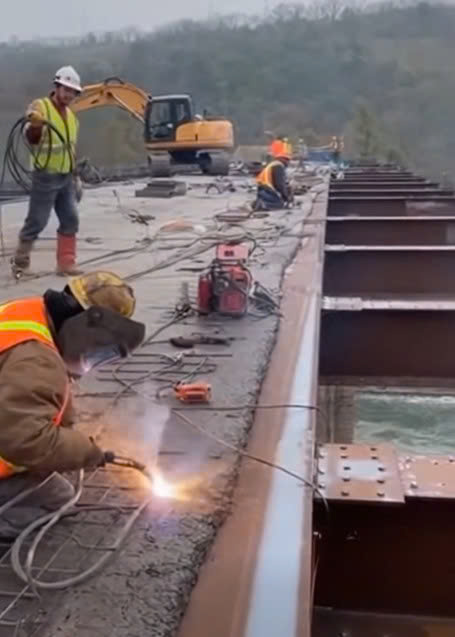
Supervisors walked along the structure, reviewing schedules and exchanging brief conversations with crew members. Materials were being repositioned, measurements double-checked, and safety protocols followed as they had been for weeks. Below, the river flowed calmly, reflecting the pale light of the early sky. Nothing hinted at the disaster that was quietly approaching.
From a nearby rooftop, the bridge looked almost peaceful. Cars moved smoothly along adjacent streets, pedestrians strolled near the riverbank, and the construction activity seemed controlled and routine. Workers appeared confident as they balanced across beams and platforms, focused on their tasks and unaware of the danger hidden within the structure.
Then a sharp, unexpected sound cut through the air. It was not loud at first, but it was distinct enough to stop conversations mid-sentence. The cracking noise echoed across the water, sending a ripple of unease through everyone who heard it. For a brief moment, the entire site froze.
The bridge began to tremble. What started as a subtle vibration quickly grew stronger, causing the steel framework to sway in ways it never should have. Tools slid across beams, and workers exchanged alarmed glances. The sense of routine vanished instantly, replaced by confusion and fear.
Someone shouted for everyone to move back. Another worker reached instinctively for nearby equipment, worried it might fall. Panic spread rapidly as the structure continued to shake, each movement more violent than the last. The air filled with the sound of straining metal and breaking concrete.
Within moments, the collapse began. Steel beams twisted under immense pressure, and large sections of concrete broke apart. Materials that had been secured seconds earlier dropped toward the river below. Sparks flew as metal collided, and dust rose into the air, partially obscuring the scene.
Construction tools, machinery, and debris plunged into the water, sending heavy splashes outward. Workers ran in every direction, some managing to reach safety just in time. Others stumbled, narrowly escaping serious harm as pieces of the bridge gave way behind them. Their voices carried across the river, filled with urgency and fear.
From the rooftop vantage point, the destruction unfolded with unsettling clarity. The bridge seemed to fall apart in stages, each section collapsing after the next. Dust clouds expanded above the river, and debris scattered across the surrounding area. The scale of the failure became impossible to ignore.
Nearby streets descended into chaos. Drivers slammed on their brakes and honked desperately as debris fell close to the roadway. Pedestrians ran for cover, pulling others with them while some instinctively raised their phones to record what was happening. The city, moments ago calm, was now in shock.
Sirens began to sound in the distance, though emergency teams were still minutes away. Rubble littered parts of the roadway, and the river churned violently where steel and concrete struck the surface. A helicopter soon appeared overhead, capturing the scene from above and revealing the full extent of the collapse.
From the air, twisted metal lay tangled where the bridge had once stood. Floating debris drifted along the river, and muddy water surged around it. Workers who had escaped gathered on higher ground, some checking themselves for injuries, others searching desperately for colleagues.
Several people tried to help one another, reaching out and offering support where possible. The unstable remains of the structure made rescue efforts difficult, leaving little room for bold action. Time seemed to slow as everyone waited, unsure of what might collapse next.
Along the riverbank, families watched in disbelief. Parents held their children close, trying to calm them while making sense of the unfolding disaster. Office workers pressed against windows, stunned by the sight of a major structure disappearing before their eyes.
Eventually, the bridge gave way entirely. What remained was a mass of bent steel and broken concrete scattered across water and land. The river roared beneath the wreckage, carrying fragments downstream. The sound of helicopters and sirens filled the air as emergency crews finally arrived.
As responders worked to secure the area, rooftop footage and aerial recordings began circulating online. Within hours, the images spread worldwide. Millions watched the collapse from different angles, each video showing the same terrifying reality from a new perspective.
Investigations would later seek answers, examining structural weaknesses and construction decisions. But in those immediate hours, the city was focused on recovery and accountability. The videos served as powerful reminders of how quickly routine can turn into disaster.
Stories of courage soon followed. Workers who helped others escape, bystanders who guided strangers to safety, and neighbors who supported one another amid confusion became symbols of resilience. Though the bridge was gone, the city’s response showed strength.
The day would not be forgotten. The rooftop footage, personal accounts, and collective memory preserved the story of fear, loss, and survival, reminding everyone how fragile even the strongest structures can be.