For hours I lay perfectly still, barely daring to breathe. Even the smallest movement threatened to send waves of pain crashing through my body. At first the cold arrived quietly, like a gentle whisper brushing against my skin. But as the sun slowly dipped behind the trees, that chill deepened, settling into my bones and refusing to leave.
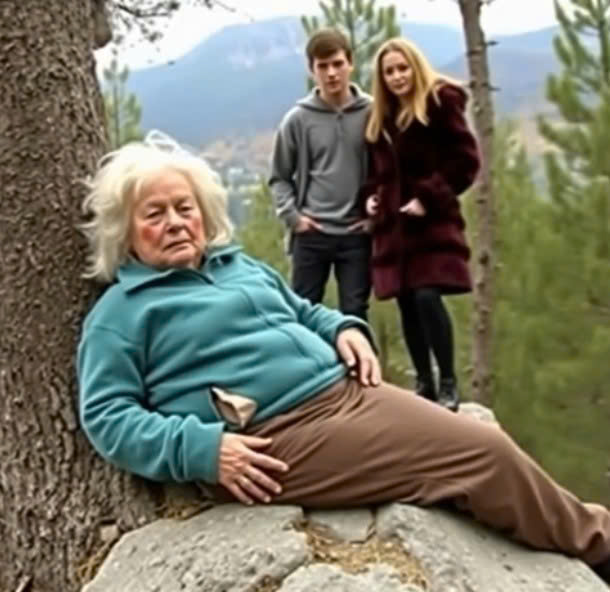
The forest, once familiar and comforting, transformed into something vast and indifferent. Long shadows stretched across the ground, and the sky shifted from soft gold to a dark, bruised shade of purple. I remained where I had fallen, staring upward, trying to understand the moment that had just shattered my life.
My head throbbed relentlessly. Each pulse felt heavy, as if my skull were echoing with the memory of the blow that had sent me to the ground.
When I carefully raised a trembling hand to my forehead, my fingers brushed against something sticky—blood that had already begun to dry. That simple sensation made everything horrifyingly real.
My own son had left me there.
The thought circled endlessly in my mind, refusing to settle into any kind of explanation. Betrayal is something people read about in novels or see in movies. It feels distant and dramatic when it happens to strangers. But when it comes from someone you raised with your own hands, it fractures your understanding of the world itself.
I tried to reconcile the boy I once knew with the man who had looked at me without hesitation. I searched desperately for reasons—anger, confusion, a moment of poor judgment.
But one explanation pressed heavily against my chest.
Money.
In the months leading up to that day, there had been tension between us. At first it seemed subtle—casual questions about insurance policies, lighthearted remarks about inheritance. I dismissed them as immaturity or impatience. I never imagined those conversations could lead to something irreversible.
As darkness fully settled over the forest, disbelief gave way to fear. The temperature dropped quickly. Night in the wilderness shows no mercy. The air grows damp, heavy, and unforgiving.
I realized with sudden clarity that if I stayed where I was, the cold might finish what had already begun.
I did not want to die on the forest floor.
Even when hope feels distant, the instinct to survive can awaken with surprising strength. Slowly, carefully, I tested my limbs. My left side protested sharply, and my ribs ached when I breathed too deeply. But nothing felt completely broken. Painful, yes—but not impossible.
I rolled onto my side.
The motion alone caused my vision to blur. I paused, breathing shallowly until the dizziness faded. Then I dragged one knee forward.
The ground beneath me was uneven—roots twisting through loose soil, leaves scattered across damp earth. Every inch required effort. I did not think about distance. I focused only on the next movement.
Crawl. Pause. Breathe.
An owl called somewhere in the distance. Branches rustled softly in the wind. The forest continued its quiet rhythm, completely unconcerned with my suffering. Strangely, that indifference fueled me. If nature was not going to save me, I would have to save myself.
After what felt like hours—though it may have been less—I spotted a fallen branch thick enough to support my weight. It lay wedged between two rocks, stripped of smaller twigs.
I reached for it and nearly cried out as pain flared through my shoulder. Still, I wrapped my fingers around the wood and pulled it closer.
Using it as leverage, I forced myself onto my knees.
The world tilted dangerously. Dark spots crowded the edges of my vision. I pressed my forehead against the branch and focused on breathing.
Inhale. Exhale. Stay conscious.
Standing was even harder. My legs trembled violently, as though they no longer trusted me to guide them. I leaned heavily on the branch, turning it into a crude walking staff.
One step forward.
Then another.
By then the moon had risen, thin but bright enough to outline the forest path faintly. I didn’t know my exact location, but I remembered a ranger station a few miles from the trailhead. If I could reach the main trail, there was a chance I could find it.
Each step sent a ripple of discomfort through my body. My boots felt heavier than usual. My breathing came unevenly. Several times I had to stop, bracing myself against a tree while waves of nausea passed.
I whispered quietly to myself.
Keep moving.
Don’t sit down.
Not yet.
Memories tried to break through my focus. My son as a small boy running ahead of me during hikes. His laughter when he tripped over roots. The oversized backpack he once insisted on carrying.
I pushed those images away. They weakened my resolve. I could face those memories later. Survival demanded my full attention.
Gradually the forest floor began sloping downward, and something about the shape of the terrain stirred recognition. It matched a bend I remembered along the main trail.
Relief flickered through me.
Fragile, but real.
I tightened my grip on the branch and continued forward.
The night passed in fragments—walk, pause, breathe, walk again. It felt endless. Yet slowly the sky began shifting from deep black to dark blue.
Dawn was coming.
When I finally saw the outline of the ranger station through the trees, it almost didn’t feel real. A small wooden building stood quietly in the early morning light. No smoke rose from the chimney, and no vehicles were parked nearby.
For a moment panic stirred.
What if no one was there?
But I forced myself forward.
The final stretch demanded everything I had left. My legs trembled uncontrollably. My hands were raw from gripping the branch.
I remember knocking weakly against the side of the building before collapsing onto the wooden steps.
The next clear memory was a voice.
“Sir? Can you hear me?”
I opened my eyes to see a young ranger kneeling beside me, his face pale as he took in the dried blood, the dirt, and the condition of my clothes.
He asked questions quickly—my name, what happened, where I was hurt. My words came slowly.
“He left me,” I managed to whisper. “My son.”
The ranger didn’t show disbelief. Instead, he immediately called for assistance.
Soon others arrived. A blanket wrapped around my shoulders. Careful hands stabilized my neck.
For the first time since the fall, I no longer had to hold myself upright.
At the hospital, bright lights replaced moonlight. Doctors moved quickly, assessing injuries and cleaning wounds. I heard fragments of their conversation—concussion, bruised ribs, dehydration.
When I told them what happened, some exchanged uncertain glances. My story sounded almost impossible. But I remained steady in my account.
In the days that followed, investigators searched the forest. Evidence was found—disturbed soil, traces of blood, items left behind.
Phone records placed my son there.
When confronted, he denied everything.
But financial records revealed debt. Messages revealed desperation. Slowly the truth emerged.
Eventually, the evidence became undeniable.
He was charged and convicted.
People often ask how it feels to see your own child sentenced. There is no simple answer. Justice does not erase grief.
What I feel most is sorrow.
Still, I wake up each morning grateful. Sunlight through the window feels different now. The sound of birds carries meaning it never had before.
That forest almost became my grave.
Instead, it became the place where I learned something powerful.
Even in betrayal. Even in darkness.
If you keep moving forward—one painful step at a time—you can still change the ending of your story.