A heavy silence hung over the veterinary clinic that morning, the kind of quiet that seemed to settle into every corner of the room. Even the staff members spoke in hushed voices, as though anything louder might disturb the fragile moment unfolding there. Officer Alex Voronov stepped through the door, gently carrying his service dog in his arms. The German Shepherd, Rex, weighed close to ninety pounds, yet Alex held him carefully against his chest as if he were still the energetic puppy he had once been.
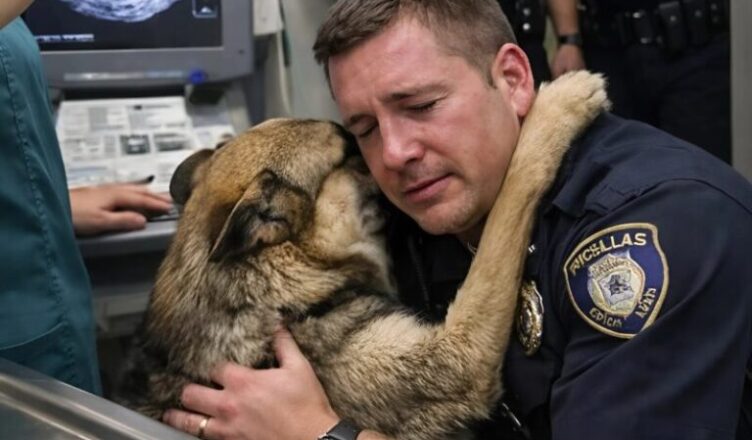
For eight years, Alex and Rex had worked side by side in the police department. Together they had tracked missing hikers deep in the woods, located hidden contraband in warehouses, and stood shoulder to shoulder during dangerous arrests that most people would never dare to face. Rex had never hesitated when duty called. To Alex, he was more than a partner—he was family.
But the strong, fearless dog who had once sprinted through forests and leaped over obstacles now lay weak and exhausted in his handler’s arms. Rex could barely lift his head. His breathing came unevenly, and every so often his paws twitched faintly, as though his body was trying to fight something it could no longer understand.
Dr. Elena, the veterinarian, stood beside the metal examination table waiting quietly. An ultrasound machine hummed softly nearby, its screen dark for the moment. Two other patrol officers stood near the wall, their expressions serious and respectful. No one wanted to speak first.
“Place him here,” Dr. Elena said gently.
Alex carefully lowered Rex onto the table, but he kept one hand resting on the dog’s neck. After years together, he knew every small movement Rex made—the rhythm of his breathing, the way his ears lifted when he caught an unfamiliar scent, the way his body tensed whenever he sensed danger nearby.
Today the breathing felt different. Too shallow. Too fragile.
Dr. Elena studied the test results once more before speaking. Her voice remained calm, but the weight of her words was impossible to ignore.
“We repeated all the examinations,” she said quietly. “His kidneys are barely functioning, and fluid is building up in his lungs. His body is extremely weak.”
Alex closed his eyes for a moment and released a long breath.
“Isn’t there anything else we can try?” he asked. “Surgery, new medication… anything at all?”
The veterinarian slowly shook her head.
“If there were even a small chance, I would tell you immediately,” she said. “Right now, continuing treatment will only prolong his suffering. The most humane option would be to let him pass peacefully.”
The words lingered in the air like a heavy weight that no one in the room could lift.
Earlier that morning, the department had already signed the authorization for euthanasia. Alex himself had signed the document as well, though the act had felt almost impossible.
One by one, the officers approached the table and gently stroked Rex’s fur.
“You were the best partner anyone could ask for,” one officer whispered.
Alex leaned down close to Rex’s ear.
“I’m right here, buddy,” he murmured softly. “You don’t have to fight anymore.”
And then something unexpected happened.
With enormous effort, Rex slowly lifted his front paws and wrapped them around Alex’s shoulders, pulling himself closer as if he wanted one last embrace.
The room fell completely silent. Rex had never done that before.
Alex felt his throat tighten, and tears filled his eyes as he held the dog carefully.
“It’s okay… I’m here,” he whispered again.
Dr. Elena had already prepared the syringe for the final injection, but as she stepped closer, she suddenly paused. Her expression shifted slightly, and she leaned nearer to Rex, watching him carefully.
“Wait,” she said quietly.
She placed her hand gently on Rex’s stomach and then moved it slowly along his side, concentrating as though trying to detect something unusual.
A moment later, she frowned.
“Turn the ultrasound back on,” she told her assistant.
The machine flickered to life, and a grainy black-and-white image appeared on the screen. The veterinarian studied the monitor carefully, adjusting the controls while the room remained perfectly still.
Seconds passed.
Then suddenly she straightened.
“Stop,” she said. “This doesn’t look like organ failure.”
The officers exchanged confused glances.
“What do you mean?” Alex asked, still holding Rex close.
Dr. Elena zoomed in on a small dark spot on the screen.
“Look here,” she said. “Do you see that?”
The image revealed a tiny irregular shape buried within the tissue.
“This isn’t inflammation,” she explained. “It appears to be a foreign object.”
She adjusted the imaging mode and examined the screen again with growing certainty.
“It looks like a very small metal fragment,” she said. “It’s lodged near important tissue and slowly releasing toxins into the body. That would explain the test results and the symptoms we’ve been seeing.”
The room went silent again, but this time the silence felt different.
“So… that means…” Alex began, unable to finish the sentence.
Dr. Elena looked at him with a new expression—one that carried a spark of possibility.
“If we operate immediately,” she said, “there’s a real chance we can remove it and stop the damage.”
The officers near the wall blinked, trying to process what they had just heard.
“A chance to save him?” one of them asked quietly.
The veterinarian nodded.
“Yes. But we have to move quickly.”
Alex held Rex even closer, and the dog still kept his paws resting on his handler’s shoulders, as though he somehow understood that something had changed.
“Did you hear that, partner?” Alex whispered, his voice trembling with cautious hope. “Looks like you’re not planning to leave just yet.”