At first glance, this puzzle looks almost too easy. Four identical glasses appear side by side, each filled to the same level with water. Inside each glass is a different object: a paperclip, a baseball, an eraser, and a wristwatch. The question seems simple enough: which glass actually contains the most water? Many people answer immediately because all four waterlines look equal. Yet that quick reaction is exactly what makes the puzzle so effective.
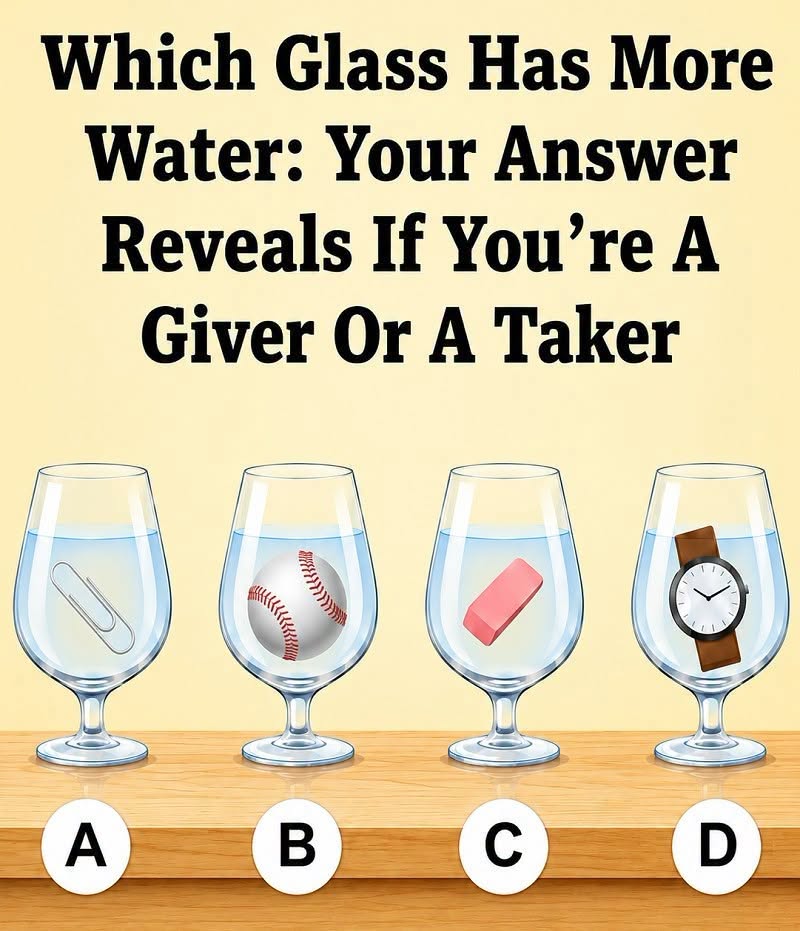
The four glasses are labeled A, B, C, and D. Glass A contains a small paperclip. Glass B contains a large baseball. Glass C holds an eraser, and Glass D contains a wristwatch. Because the water reaches the same visible height in every glass, the first instinct is often to assume that each container holds the same amount of water. But that conclusion ignores one important factor: the objects themselves are taking up space inside the glasses.
The key to solving the puzzle is displacement. When an object is placed into water, it occupies volume that water would otherwise fill. If the containers are identical and the water reaches the same level in each one, a larger submerged object means there is less actual water in that glass. A smaller object leaves more room available for water.
Once you think about the puzzle that way, the answer becomes much easier. The baseball in Glass B takes up a large amount of space. The eraser in Glass C and the watch in Glass D also occupy more volume than the paperclip. Glass A contains the smallest object, so it displaces the least water. That means Glass A has the greatest amount of water remaining inside.
The puzzle works because our brains are designed to make fast judgments. We see equal water levels and naturally connect equal height with equal quantity. In many everyday situations, that shortcut is useful. However, visual information can sometimes hide variables that matter just as much as what we can immediately see. Here, the missing piece is not the waterline but the amount of space occupied below it.
This is also why simple visual puzzles can be surprisingly valuable. They encourage people to slow down and question the first answer that comes to mind. Instead of relying only on appearance, you have to think about how the physical system works.
The principle behind the puzzle is straightforward science. An object placed in a liquid displaces an amount of liquid related to the volume of the submerged portion of that object. In a glass with fixed dimensions, the available space must be shared between the water and whatever object is inside. If all the glasses are filled to the same level, then the glass containing the smallest submerged object will hold the most water.
Of course, real-world versions of this puzzle can become more complicated if objects float, are only partly submerged, or have unusual shapes and densities. But in the simplified image, the intended assumption is that the objects are inside the water and the glasses are otherwise identical. Under that condition, Glass A is the logical answer.
Part of the puzzle’s popularity comes from the playful personality descriptions often attached to each choice. These interpretations are not scientifically validated, but they can make the activity more entertaining. Someone who chooses Glass A may be described as detail-oriented and analytical because they noticed the relationship between object size and water volume.
A person who chooses Glass B might be characterized as fast-moving and instinctive, someone who tends to make confident decisions based on the most noticeable feature. Someone who picks the eraser may be described as balanced or exploratory, while a person choosing the watch might be labeled intuitive or symbolic. These descriptions are best treated as lighthearted commentary rather than genuine psychological assessment.
The more meaningful lesson has nothing to do with personality labels. It is about critical thinking. Many problems in daily life contain hidden variables that are easy to overlook because something else captures our attention first. A business decision may look profitable until overlooked costs are considered. A disagreement may seem simple until you understand the other person’s perspective. A household problem may appear obvious until one small detail changes the entire explanation.
The smartest question is often not, “What is the answer?” but, “What am I missing?” That habit creates space for better reasoning. It encourages you to separate what you actually know from what you merely assumed. The water puzzle demonstrates this beautifully because the most important clue is also the least dramatic object in the picture.
The tiny paperclip seems almost irrelevant compared with the baseball, eraser, and watch. Yet its small size is exactly why Glass A contains more water. The puzzle rewards attention to relationships rather than attention to spectacle.
Ultimately, this simple challenge is a useful reminder that equal appearances do not always represent equal realities. What we see first is not necessarily the complete story. Whether you solved it immediately or chose another glass, the value lies in understanding why the answer works.
So the next time an answer seems obvious, give yourself a moment. Look beyond the surface, identify the hidden variables, and test your assumptions. Sometimes the smallest detail changes everything. In this case, that detail is a paperclip, and it is enough to turn an easy-looking children’s puzzle into a lesson in careful reasoning.