Shane Jones had spent fifteen years training United States Marines in hand-to-hand combat, teaching them how to read danger before it arrived and neutralize threats with precision rather than rage. Now, at forty-eight, his life was quieter. He found calm in woodworking, in the discipline of shaping raw material into something solid and lasting. On that afternoon, he stood in his garage sanding a cherrywood box he was building for his daughter Marcy’s birthday, focused on straight edges and clean joints, letting the rhythm steady him.
The garage door creaked open. Marcy stepped inside. She was twenty-two, her dark hair twisted into a loose knot, wearing a long-sleeved turtleneck despite the summer heat. Shane looked up and instantly felt something shift. Years of training had taught him to notice small things—hesitation in movement, guarded posture, the way someone protected one side of their body without realizing it.
“It’s beautiful, Dad,” she said quietly, running her fingers over the smooth wood. When she stepped closer, there was the slightest hitch in her gait. Her eyes flicked away too quickly.
“How’s Dustin?” Shane asked casually, keeping his voice even.
“Good,” she replied. A pause. “Really good. He’s been teaching me some boxing stuff. It’s fun.”
The delay told him more than her words ever could. She backed away moments later, saying her mom needed help inside. Shane watched her go, his jaw tightening. He’d never liked Dustin—not from their first handshake, too firm and too performative, the kind of grip meant to assert dominance rather than respect.
Dinner confirmed his instincts. After Marcy left the table, Lisa, Shane’s wife and a seasoned trauma nurse, leaned close. “She has bruises,” she whispered. “Upper arm. Finger marks. She said she hit a door frame.”
Shane felt the familiar cold settle in his chest. “He touched her.”
“She’s scared,” Lisa said, her voice strained. “Whatever you do, do it legally.”
Shane didn’t answer. Some lines, once crossed, demanded more than quiet patience.
For the next two weeks, he observed. He drove past Titan’s Forge, the gym where Dustin trained, noting routines and faces. He made calls to old contacts. One of them, Gabriel, now working as a private investigator, dug deep.
“Your daughter’s boyfriend has a history,” Gabriel reported. “Multiple assault arrests, a restraining order, and ties to the Southside Vipers. His uncle Royce runs the operation.”
That explained everything—Dustin’s confidence, his recklessness, the fear in Marcy’s eyes.
Shane sat with that information through the night. By morning, the anger had cooled into something deliberate and controlled. Until Lisa called from the hospital.
“She’s in the ER.”
Marcy had a concussion, bruised ribs, injuries no accident could explain. Witnesses reported an argument with Dustin outside his gym an hour earlier.
Shane didn’t go to the hospital first. He drove to Titan’s Forge.
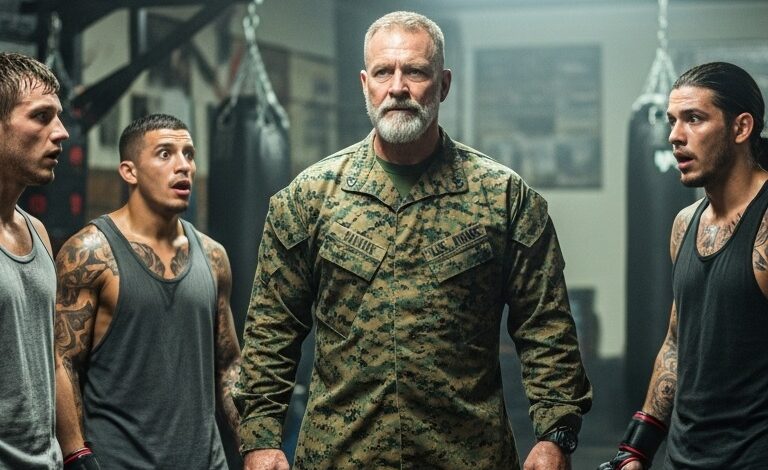
The gym pulsed with noise and motion. Fighters sparred, music thumped, sweat hung heavy in the air. Dustin stood near the cage, laughing with his coach. When Shane walked in, the room quieted—not because of who he was, but because of how he moved. Calm. Focused. Unafraid.
“You put your hands on my daughter,” Shane said quietly.
Dustin smirked. “She needed to learn respect.”
Three men shifted closer. The coach stepped forward, posturing. “You should leave, old man.”
Shane looked at them calmly. “I spent fifteen years teaching Marines how to dismantle threats. You should reconsider.”
They didn’t.
The confrontation was brief and decisive. Shane defended himself with controlled efficiency, disabling attacks without excess force, reacting to each movement with practiced precision. When it ended, Dustin was shaken, cornered, and finally aware of the gravity of his actions.
“You will never touch her again,” Shane said evenly. “If you do, this will be the least of your problems.”
Phones recorded everything. Shane wanted witnesses.
Police arrived the next morning. Shane cooperated fully, detailing the assault on his daughter, the attempted escalation at the gym, and his actions in self-defense. Detectives reviewed Dustin’s record and the Vipers’ reputation. No charges were filed against Shane.
That didn’t stop retaliation.
By afternoon, Shane was fired. Royce Clark had made sure of it.
That was when Shane understood this was bigger than Dustin.
Over the following month, he moved with purpose. Using a false identity, he infiltrated the Vipers’ underground fighting operation, gaining trust and access. He documented everything—illegal fights, financial records, names, connections—and quietly passed it all to a federal agent who had been chasing Royce for years.
When Royce organized the largest illegal event of the year, Shane stepped into the cage, not to win, but to buy time.
Mid-match, the lights flickered—the signal.
Federal agents flooded the building. Chaos erupted. Royce tried to escape, then rushed the cage in desperation. Shane disarmed and restrained him until authorities took control.
By morning, dozens were arrested. Judges and corrupt officials were exposed. The organization collapsed.
Dustin was denied bail.
Eight months later, Shane faced no charges. His cooperation had dismantled a criminal network.
Marcy recovered. The city felt safer.
Two years later, Shane sat on his porch holding his infant grandson, the cherrywood box resting nearby.
He had used every lesson he’d ever learned to protect what mattered most.
And finally, he could breathe.