For years, my life followed a quiet, suffocating routine shaped entirely by my husband’s control. Mark never needed to raise his voice in public. He didn’t have to. At home, his presence alone dictated everything I did. What I wore, who I spoke to, when I checked my phone, how I explained myself. To the outside world, he was attentive and polite, the kind of man people trusted instantly. Inside our house, he watched me constantly, measuring my movements, correcting my words, reminding me who held the power.
I learned to survive by staying silent. When bruises appeared, I told myself stories that sounded harmless. I was clumsy. I fell. I bumped into things. Repeating those excuses became a shield. The fewer questions people asked, the safer I felt. Silence became my habit, then my prison.
Everything collapsed on a rainy Tuesday morning. The argument started over something insignificant, as they always did. His anger filled the room, sharp and overwhelming. I remember a sudden pain, a flash of light, and then nothing at all.
When I opened my eyes, I was in the car, my head throbbing as Mark drove with exaggerated urgency. His voice was calm, almost tender. “You fell down the stairs,” he said. “That’s what happened.” Even through the haze, I understood what he was doing. He was rewriting reality again, and I was expected to accept it.
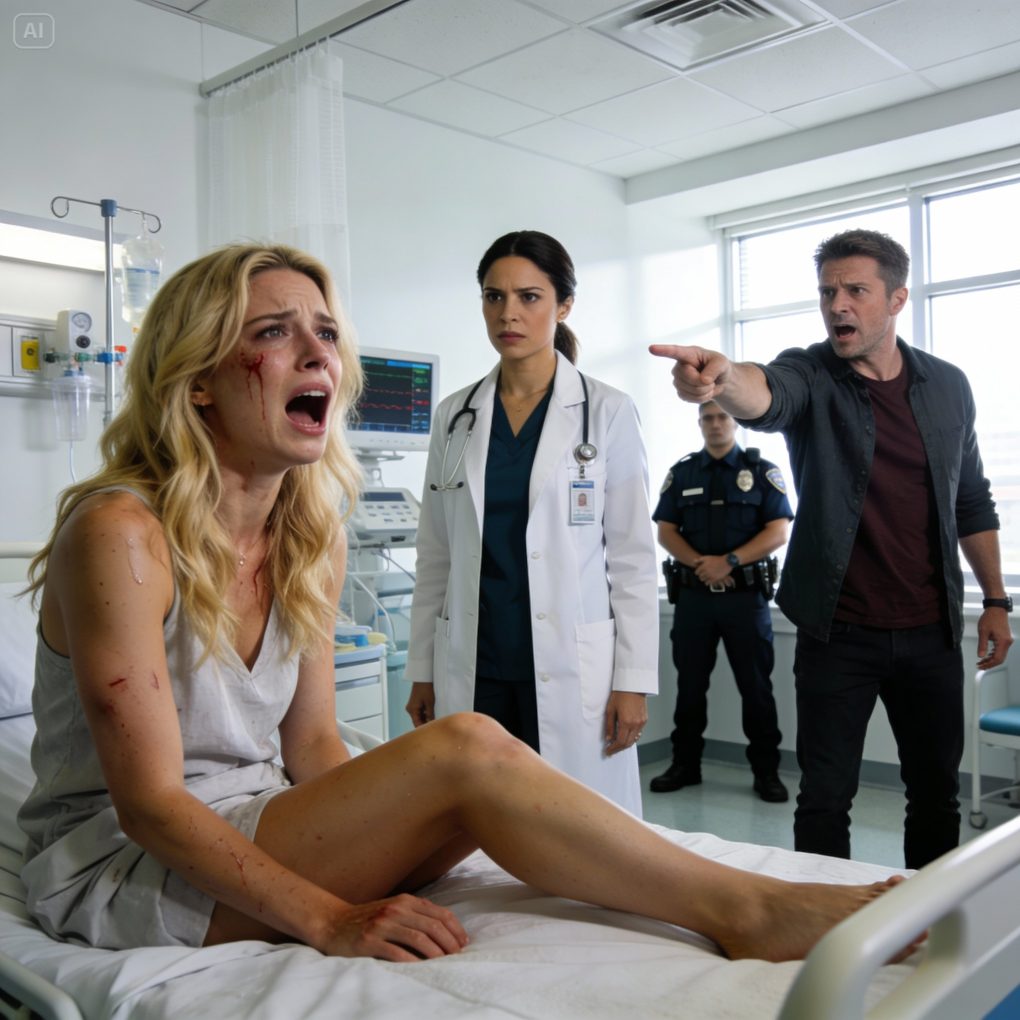
At the hospital, he played his role flawlessly. He held my hand, spoke gently to the staff, and repeated the same story. I tried to speak, but my throat closed. Years of fear kept me still. I felt smaller than ever.
Then the doctor entered.
Dr. Harper examined me carefully, her movements calm but precise. She didn’t rush. Her eyes lingered on details I had learned to hide: the fading marks, the newer injuries, the patterns that didn’t match accidents. She didn’t ask me questions. Instead, she turned toward my husband.
Her voice was firm and unmistakable. She told security to lock the door and call the police.
The room froze. For the first time in years, Mark lost control of the moment.
Security arrived quickly and asked him to step back. He protested, insisting there had been a mistake, insisting I was confused. I said nothing. I didn’t need to. He was escorted out, his voice fading down the hallway. When the door closed behind him, I felt something shift inside my chest, like air rushing back into lungs that had forgotten how to breathe.
Dr. Harper sat beside me and spoke gently. She told me I wasn’t to blame. That I didn’t owe anyone an explanation. That help was available whenever I was ready. I cried then, not from pain, but from the shock of being believed.
The hours that followed were quiet but purposeful. Photos were taken, notes recorded, options explained. A social worker arrived and offered choices instead of commands. Emergency housing. Legal protection. Support. For the first time, I was asked what I wanted.
As night turned into morning, I sat wrapped in a blanket, exhausted and shaken, but aware that something had ended. It didn’t feel like my life was falling apart. It felt like a door closing behind me.
The days afterward blurred together. Court documents, interviews, careful decisions. I moved into a temporary apartment arranged for my safety. It was small, simple, and silent. That silence frightened me at first. Freedom, I learned, wasn’t immediate relief. It was unfamiliar space.
My body healed faster than my mind. Bruises faded, but memories lingered. Some nights I woke convinced I heard his voice. Other nights, I lay awake wondering how I had survived so long inside something that now felt impossible.
Still, each day I did one small thing for myself. A walk outside. A phone call to someone I had stopped speaking to. Sitting in a café without fear. Each choice felt like reclaiming ground inch by inch.
Weeks later, I returned to the hospital to thank Dr. Harper. She smiled and told me I had saved myself. She had only opened the door. That image stayed with me.
I joined support groups and listened to stories that echoed my own. One evening, I spoke too. My voice shook, but I spoke. And when I finished, I felt lighter.
Months passed. Healing wasn’t a straight line. Therapy helped me understand what safety meant to me now. I took self-defense classes, learned how to stand my ground, how to trust my body again. I returned to work I had once been discouraged from pursuing and slowly rebuilt my independence.
Fear still appeared at unexpected moments. Trauma didn’t vanish neatly. But life expanded around it.
One afternoon in a café, I overheard a young woman apologizing repeatedly on the phone. I recognized that tone instantly. For the first time, instead of fear, I felt purpose.
I began volunteering with a local organization that supported survivors. I listened. I helped where I could. I learned that presence alone could matter.
When my husband later attempted to challenge the protective order, I stood in court and spoke clearly. The judge upheld it. Walking out, I understood that this wasn’t just a legal decision. It was a line I would never cross again.
Spring arrived quietly. I moved into my own apartment and filled it with things I chose. One evening, I rediscovered old sketches and felt creativity return. I titled a small art series “Doors,” each piece marking a moment of change.
At the exhibition, someone told me my work felt like her story. I realized then why I had written all of this.
Because someone else might need to read it.
You are not weak for staying. You are not broken for hurting. And the moment you choose to step forward, no matter how small, your life can begin again.